The Lid-Up Audit: Why Bin Day Is a Brand Strategy Session
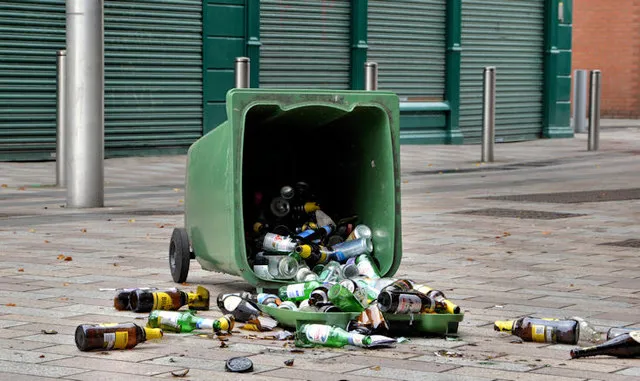
Photo: Albert Bridge , CC BY-SA 2.0, via Wikimedia Commons
There's a moment most brands never brief anyone to design. It happens at about 6.47am, in the drizzle, with one hand holding a bin bag and the other trying to keep a recycling box lid from flapping down the street. It is not photogenic. It will never make the case study. But it is one of the most honest interactions a customer will ever have with your brand.
We spend a fortune on the unboxing: the tissue paper, the magnetic clasp, the little card thanking us for being part of the journey. Then the customer gets to the binning, and the brand either helps or hinders. That gap between the reveal and the removal is where trust quietly accumulates or leaks away.
The bin is a focus group that never lies
In a nice meeting room, people will tell you the packaging feels premium. On bin day, they will tell you the truth. Does it collapse? Does it leak? Does the sleeve hide a plastic film that nobody knows what to do with? Does the recycling label require a magnifying glass and a degree in local authority logistics?
UK households are not short of rules to remember. Kerbside collections differ from council to council, flats often have different arrangements, and soft plastics are a postcode lottery of supermarket drop-off points. A brand cannot solve all of that. But it can stop pretending the customer has unlimited time, perfect eyesight and a laminated guide to their local waste service.
The bin is a focus group because it removes politeness. Nobody is trying to impress you at the kerb. They are trying to get back inside before their slippers get wet.
The instructions are the postscript
Disposal copy is still copy. It deserves the same care as a headline, not a legal afterthought in four-point type. 'Recycle me' is not an instruction; it is a mood. 'Flatten carton, keep cap on, bag this bit separately' is an instruction. One gives the customer a vague sense of virtue. The other gives them a route.
This is not about writing a sustainability essay on the back of a cereal box. It is about microcopy that works when someone is half awake and using one hand. Short verbs. Clear icons. Plain English. A visible cue for the bit that cannot go in the kerbside bin. If a QR code sends people to a generic homepage, it is decoration. If it opens a simple postcode checker or a one-screen guide, it is a service.
The test is not whether the instructions look tidy in a design review. The test is whether they survive contact with a Tuesday morning.
The wheelie bin is a trust barometer
There is a particular British social anxiety attached to bin day. Nobody wants to be the house whose recycling blows into next door's hedge. Nobody wants the bin lorry to pause, inspect their box and leave a note. Packaging that creates that small public embarrassment is packaging that has misunderstood its job.
A brand does not need to make bin day delightful. It needs to make it uneventful. That means thinking about storage before collection: does the pack smell, leak or take up half the kitchen? It means thinking about compression: can it be flattened without a fight? It means thinking about the full journey, not just the moment the product is lifted out of the box.
This is especially true for subscription brands, food producers and anyone shipping direct to homes. The customer is not just buying the product; they are inheriting the waste. If that inheritance is awkward, the brand becomes the thing that created extra work.
A practical bin-day audit
You do not need a research budget to do this. You need a bin, a wet morning and a willingness to look silly.
- Keep a week's worth of your own packaging. Do not tidy it into a neat pile. Keep it as a household would.
- Recreate the real conditions: early, rushed, low light, one free hand.
- Check the rules for at least three different postcodes, including a flat and a rural address.
- Time the disposal. If it takes more than twenty seconds and the pack offers no clear cue, simplify something.
- Do the smell, leak and storage test. Leave it somewhere warm for a day. See what happens.
- Try to flatten it and fit it in a standard kerbside box or bin.
- Ask somebody outside your category to sort it without help. Film the confusion. That footage is more useful than another brand tracker.
- Fix one thing properly, rather than adding a twelve-point sustainability manifesto to the pack.
- Update the digital instructions too. The website is part of the bin day experience.
- Repeat next season. Packaging changes; council rules change; households change.
Make waste part of the creative brief
At Blue Lemons, we are fond of the odd, unglamorous touchpoint that everyone else has skipped past. The wheelie bin is not a campaign channel you control. It is a promise test you cannot escape. Your tone of voice does not matter much when a bin lid is stuck. Your values are not much comfort when a recycling box is leaking.
So put disposal in the brief from the start. Not as a compliance box to tick, but as a design problem worth solving. The brand that thinks about the removal as carefully as the reveal is the brand that feels joined-up after the sale. The unboxing is theatre. The binning is character.
And if you want to stand out, do not just design the moment someone opens the box. Design the moment they get rid of it. The wheelie bin will not read your deck, but it will tell you whether your brand made someone's morning easier.